The Moat Went Free: Amazon Opened Premium A+ to Everyone and Put Your AI on the Record
Two Amazon changes landed within weeks of each other this spring. Read on their own, they look like good news and a rounding error: a powerful listing tool became free, and a small checkbox appeared during image upload. Read together — and from the seat of a large brand — they are the same message written twice. Amazon just deleted an advantage the incumbents paid for, and quietly started the paper trail that will be used against the incumbents first.
Let's be provocative on purpose, because the polite framing ("democratization!") hides what actually happened to the balance of power on the shelf.
What changed, in plain terms
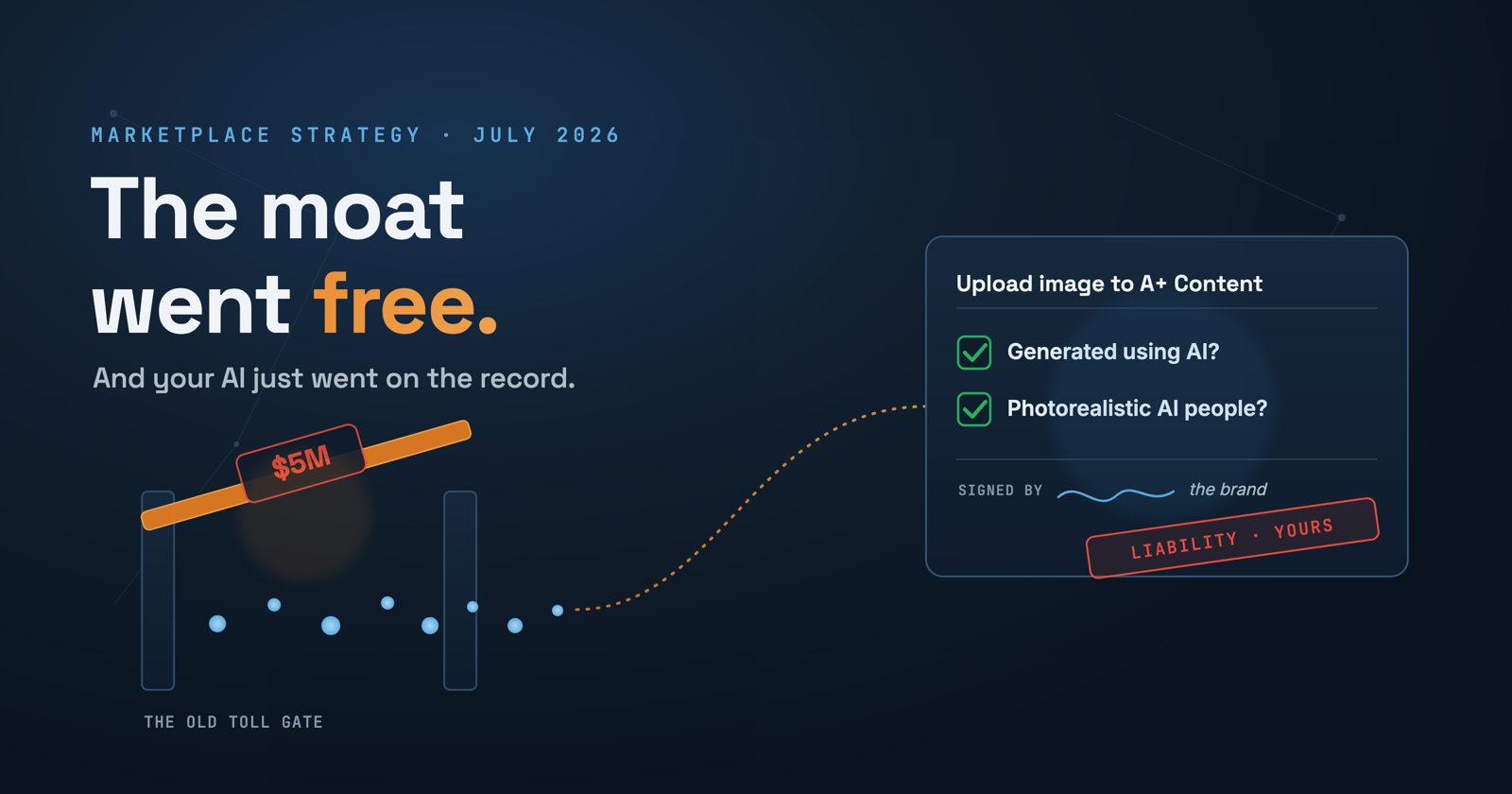
Change one — the toll gate fell. Premium A+ Content — the rich modules on a product page: video carousels, hotspot images, real comparison tables, full-width hero banners, expanded text — used to sit behind a wall most brands never scaled. The barrier was reported at roughly $5M in sales, plus invite-only access and a qualification process of several approved A+ submissions. As of a rollout first reported 18 May 2026 and confirmed through Seller Central notifications around 21 May, Premium A+ is now enabled by default for every Brand-Registered seller, at no extra cost. No threshold. No waitlist. No invite.
Change two — the checkbox went on the record. Upload an image to an A+ module or a Brand Story now and you meet two mandatory questions: Was this generated using AI? and, separately, Does it feature photorealistic AI-generated people? You answer both before the upload proceeds. Surfaced across the seller community in mid-June 2026, it is not — yet — enforcement. There is no shopper-facing "AI-generated" badge, no suppression, no account-health hit. Amazon is building a data layer before an enforcement layer.
One accuracy note the headlines blur
"Free for all sellers" means all Brand-Registered sellers. Brand Registry is still the ticket. If you're not enrolled, the gate that matters for you didn't move — which, for the enterprise brands this piece is about, is a distinction without a difference. You're all Registered.
Why "free" is a threat, not a gift, to big brands
For a decade, Premium A+ did quiet work for large brands: it was a paid moat. If you had the revenue and the account maturity, you could buy your way into the richest storytelling real estate on the page — and the challenger brand three positions down couldn't. That asymmetry was worth real money. It is now worth $0, because everyone has it.
Democratization is a friendly word for de-moating. Amazon didn't hand you a new capability — it deleted a barrier that used to protect you, and gave the identical toolkit to every insurgent on your category page.
And Amazon told you exactly where the fight moves next. Alongside the expansion it introduced a Content Quality Score that grades A+ modules on completeness, image quality, and module mix. When access is free, the platform stops rewarding access and starts rewarding craft. The moment of democratization is simultaneously the moment of professionalization. Your differentiation can no longer be "we have Premium modules." It has to be "our content is measurably better than the DTC upstart who now has the same modules and one hero SKU to perfect while you have four thousand to maintain."
Now the uncomfortable half: the checkbox is aimed at you
Small sellers experimented with a few AI images. Large brands did something different — they industrialized it. Synthetic lifestyle scenes, AI-composited models, generative background swaps, rendered "in-use" shots produced at catalog scale to fill thousands of ASINs across dozens of markets, fast and cheap. That was the efficiency win of the last two years.
Every one of those uploads now carries a self-declared checkbox — which means every one of them becomes an auditable admission. Here is the part enterprise legal teams should sit up for: Amazon has effectively told the community it cannot reliably detect AI-generated humans in imagery. The entire system runs on self-disclosure. Think of it like a tax filing. Nobody audits every return — but the liability for an accurate declaration sits with the filer, not the platform. Amazon built the form and handed you the pen.
That structure is brutal for a large brand and trivial for a small one, for a simple reason: scale cuts both ways.
- You have a retroactive backlog. A challenger has twelve images to review. A global brand has a decade of AI-composited creative across every market to reconstruct and re-tag correctly on re-upload.
- You are the enforcement target. When the metadata layer becomes the enforcement layer — and the whole point of collecting the data is to eventually write the rules — regulators and class-action lawyers do not go after the seller with 40 units a month. They go after the deep-pocketed, globally-visible brand with a legal department. Undisclosed synthetic content becomes your exposure, not Amazon's, by design.
- You operate in every jurisdiction at once. A small US seller can ignore Brussels. You can't.
The regulatory clock is already running
This is why Amazon read the room and built the checkbox now. The disclosure infrastructure is a direct response to a fast-moving global regime — and the deadlines are close:
| Rule | Status | What it targets |
|---|---|---|
| EU AI Act, Article 50 | Compliance 2 Aug 2026 | Transparency for AI-generated / AI-manipulated content |
| New York A8887-B | Live June 2026 | Synthetic performers in advertising |
| California AB 2602 | Live Jan 2025 | Digital replicas of real performers |
| FTC Endorsement Guides | In force | Extended "clear & conspicuous" disclosure to AI / virtual influencers |
Note the important nuance, because over-disclosure has its own cost. The strictest rules — New York's, and the second checkbox — care about AI-generated human likeness, not AI-rendered objects. A synthetic model or digital human triggers the exposure. An AI-generated park bench, skyline, or background behind a real person generally does not. Minimal retouching — background removal, colour correction, lighting — is out of scope entirely. The line is drawn at manufacturing a person, not at using the tool.
The double bind for the CMO
Put the two changes together and a large brand is squeezed from both sides at once:
| Lever | Yesterday (advantage) | Today (repriced) |
|---|---|---|
| Premium A+ access | Bought with $5M+ scale; a moat | Free to every rival; a commodity |
| Content quality | Unmeasured, self-asserted | Graded by Amazon's Quality Score |
| AI creative at scale | A cheap efficiency win | A self-signed, auditable admission |
| Legal exposure | Diffuse, deferrable | Concentrated on the biggest name |
The reflex for some brands will be to quietly not tick the box and hope the non-detection holds. That is precisely the move that converts a compliance formality into a future enforcement headline with your logo on it. The other reflex — strip AI creative entirely — throws away a genuine cost and speed advantage and ignores that a subset of shoppers now expect disclosure. Neither reflex is a strategy.
What a serious brand does now
- Stop treating "free" as a win and treat it as a starting gun. Re-audit your highest-traffic ASINs against the new Quality Score — completeness, image quality, module mix are now literally graded. Assume every competitor is upgrading to Premium this quarter; your edge has to be craft, not access.
- Build an AI-provenance ledger for your catalog. Know, per asset, whether it was AI-generated and whether it depicts a synthetic human. You cannot disclose what you haven't inventoried, and reconstructing that history retroactively is the single most expensive version of this task.
- Tag honestly on re-upload — especially for AI people. It costs nothing and it's mandatory going forward. Brands that tag correctly from the start are in a vastly better position when enforcement arrives than brands forced to explain a gap later.
- Separate "AI object" from "AI person" in policy. The compliance heat is on synthetic human likeness. Route those assets through legal review and disclosure copy; don't over-declare a rendered background into a liability it isn't.
- Decide your disclosure posture deliberately. With 63% of consumers expecting disclosure — and a distrustful minority reacting to the word "AI" — measure the conversion effect on your own listings rather than guessing. The requirement is non-negotiable; how you present around it is yours.
Amazon just changed what your money used to buy. It no longer buys access to the premium shelf — everyone's on it now. What it should buy instead is the discipline to make better, compliant, provably-yours content faster than the challengers who just walked through your open gate.
The gate is down. The checkbox is on. For the big brands that spent a decade compounding structural advantages on Amazon, the honest summary is uncomfortable and clarifying at once: your moat was just repriced to zero, and your shortcuts were just put on the record. The winners from here won't be the brands that got in — everyone's in. They'll be the ones who treat the detail page as what Amazon just told you it is: a graded, provenance-tracked shelf where craft and honesty are the only moat left to build.
Sources
- My Amazon Guy — "Amazon Premium A+ Content Free for All Sellers Removes a Major Barrier" (default rollout; May 18 / May 21 2026 dates; Quality Score; module list).
- Parker-Lambert — "Navigating Amazon's New AI Disclosure Requirements for A+ Content" (the two checkboxes; metadata-not-enforcement; scope of "minimal retouching"; June 19 2026).
- Logie — "Amazon's AI Content Checkbox" (self-disclosure model; Amazon can't detect AI people; NY A8887-B, CA AB 2602, FTC guides; $53K penalty; 63% consumer figure; EU AI Act Aug 2 2026).
- EU Artificial Intelligence Act — Article 50 transparency rules (compliance deadline 2 Aug 2026).
- New York State Senate — Bill A8887-B (synthetic performers in advertising; effective June 2026).