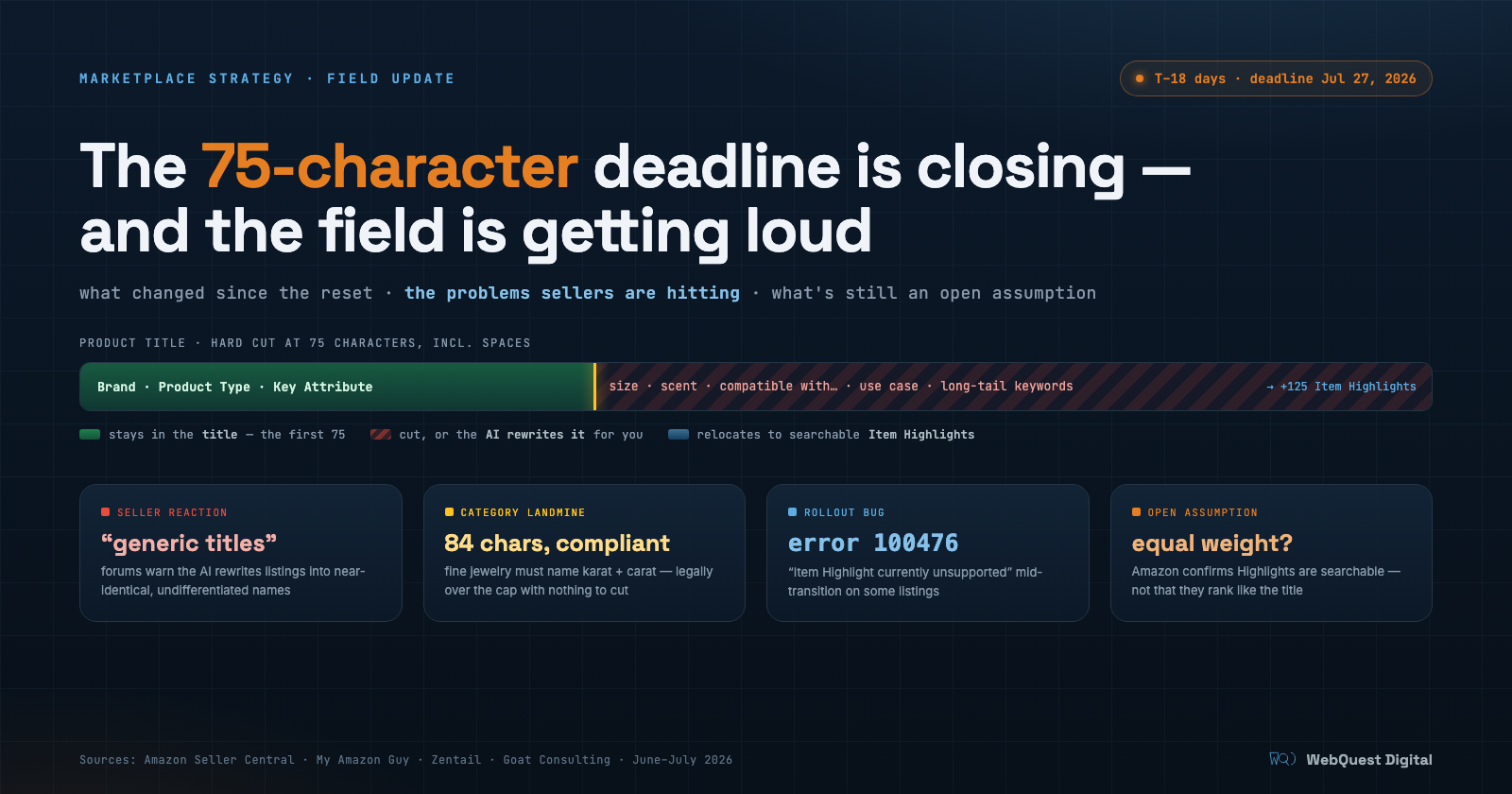
The 75-Character Countdown: What Changed, What's Breaking, and What's Still a Guess
Eighteen days out from Amazon's July 27 short-title deadline, the conversation has moved on. The question is no longer what the rule says — it's what breaks when a real catalog meets it, and what it does to your organic SEO, your standing with Rufus, and ultimately your conversion. A field update on the latest discussions, the category-level problems, the assumptions no one has proven yet — and why this belongs on the desk of whoever owns eCommerce, now.
We laid out the strategic frame a few weeks ago in The 75-Character Reset: on July 27, 2026, Amazon caps product titles in every non-media category at 75 characters including spaces, opens a new 125-character searchable Item Highlights field for the overflow, and — if you do nothing — lets its own AI rewrite over-limit titles, with a 14-day window for brand owners to review. Those facts haven't changed. What has changed is the temperature.
With the deadline now inside the three-week window, the seller community has shifted from clarifying the policy to stress-testing it. The result is a clearer picture of where this lands cleanly, where it genuinely breaks, and which parts everyone is still guessing about. Here is where the topic actually stands today — and how we're advising clients to read it.
The mood — latest discussions
The debate turned from "how" to "who holds the pen"
The single loudest thread in the last few weeks isn't the character count — it's the AI rewrite. Sellers have realized that "do nothing" is not neutral: it hands an automated system the decision of which of their words matter most. The reaction has been blunt.
"The AI wants to make all of my listings generic non-descriptive titles all exactly the same word for word."
— Amazon seller, Seller Central forum thread
The complaint underneath the noise is legitimate. An averaging model optimizing for compliance tends to sand down exactly the distinctiveness that makes a listing findable — the compatibility note, the specific use case, the one attribute that separates your product from the ten next to it. A second recurring worry is scale: operators with thousands of parent-and-child variations don't see 14 days as a safety net, they see it as an impossible manual queue. "That will kill my listings," one wrote. The takeaway from the field is consistent: treat the AI window as a fallback, not a plan, and rewrite your priority ASINs yourself so the model has nothing left to touch.
The problems — where it actually breaks
Three failure modes have surfaced since the announcement
Early on, the story was clean: trim your titles, move the rest to Item Highlights. Three weeks of real catalogs have exposed the edges. These are the concrete problems now dominating the discussion.
100476: Item Highlight currently unsupported" error, and enrollment in the AI-review flow has been inconsistent — so the "just use Item Highlights" advice doesn't yet work everywhere.None of these are reasons to panic — but they are reasons not to leave your regulated or descriptor-heavy listings to an automated pass. If you operate in jewelry, art, supplements, or any category with mandatory title language, this is where expert eyes belong before the deadline, because compliance risk and search visibility are both on the line and Amazon has not yet resolved the tension.
The assumptions — what's still a guess
The most important number in this change is unconfirmed
Here is the part the confident hot-takes skip. The whole "just move it to Item Highlights" strategy rests on an assumption Amazon has not confirmed: that a keyword in Item Highlights ranks at the same weight as the same keyword in the title. Amazon has stated the field is searchable. It has not stated the weighting is equal — and until that's tested on live listings, treating the two as interchangeable is a bet, not a fact.
Our working assumption is that title real estate is still the most valuable real estate, and Item Highlights is a strong second — not a like-for-like replacement. We'd rather measure that than assume it.
Two more open questions sit alongside it: whether AI-rewritten titles will actually out- or under-perform hand-written ones in conversion, and how much a shorter title moves conversion at all in a given category. Nobody has clean data yet. That uncertainty isn't a reason to wait — it's a reason to instrument the transition so you're reading results in weeks while others are still arguing next year.
Why this matters — three fronts at once
This isn't a title edit. It moves SEO, the AI shelf, and conversion together
The reason to treat July 27 as more than a compliance chore is that it lands on three parts of the funnel simultaneously — and very few single changes do that. Get it right and you compound gains across all three; get it wrong and you can quietly bleed on each. Here is how the impact breaks down, with the categories where it bites hardest.
1 · Organic SEO — your indexation is on the line
For fifteen years the title was the densest keyword surface a brand fully controlled. Cutting it to ~12 words threatens the indexation of every long-tail term that used to live there. Position compounds the effect: in our ranking studies a search phrase in the first word of a title landed in the top decile of results about 19% of the time, versus roughly 9% when buried at word 10 or later. A shorter title mechanically front-loads your best term — a gain — but only if you choose that term deliberately instead of letting an averaging AI pick.
Where it bites: supplements & grocery (long "240 count · vegan · gluten-free · non-GMO" strings that carried dozens of indexed terms), electronics & accessories ("compatible with iPhone 15 / 14 / 13" — compatibility is the discovery query), and apparel (size, fit and occasion terms). In these categories, the keyword you drop is the traffic you lose — unless it's proven not to convert.
2 · The AI shelf — Rufus reads the fields you're now forced to structure
This change arrives in the same year Amazon folded Rufus into Alexa for Shopping and started routing real purchase intent through an assistant that reads your listing before it recommends it. Amazon has confirmed Rufus generates answers from listing data, reviews and Q&A; the COSMO layer reads structured product attributes. Item Highlights — clean, comparison-ready facts like material, dimensions, compatibility and use case — is exactly the extractable input the assistant needs to match your product to a spoken question. Handled well, the 75-character reset can make you easier for the AI shelf to recommend than a 200-character keyword soup it had to untangle.
The cap forces the same discipline the AI shelf already rewards: say clearly what the product is, prove it with specifics, and stop hiding the answer at character 140.
Where it bites: considered-purchase categories where shoppers ask the assistant to compare — appliances ("which blender for smoothies"), supplements ("magnesium for sleep"), baby ("stroller for travel"), beauty ("fragrance-free moisturizer for sensitive skin"). In these, well-written Item Highlights become the comparison fuel the AI quotes back. Our hypothesis (label it as ours): brands that write Highlights as extractable, verifiable claims get surfaced more readily in AI answers than brands that dump leftover keywords there.
3 · Conversion — the endgame, and the quietest risk
A cleaner title usually lifts mobile click-through. But conversion moves on a knife's edge: cut the one attribute that decides the purchase and you don't just lose sales, you invite the wrong clicks — traffic that bounces or returns, dragging unit-session rate and ad efficiency (ACOS/TACoS) with it. The title change can raise CTR and conversion together when the deciding attribute survives, and silently lower both when it doesn't.
Where it bites: health & personal care ("unscented / fragrance-free / dermatologist-tested" often is the buying reason), auto & electronics accessories ("compatible with [model]" prevents wrong-fit returns), and grocery (dietary flags like "gluten-free / keto" that gate the decision). The winners protect the deciding attribute in the first 75; the losers optimize for a clean look and wonder why conversion slipped.
The stakes — a management call, not a copy task
This resets the balance of power on the shelf — you can win or lose share
Put the three fronts together and the conclusion is uncomfortable: because every brand faces the same deadline, relative position resets on July 27. The SERP is close to zero-sum — if you optimize deliberately while competitors let Amazon's AI average their titles, you take share at every gate of the funnel; if you stall, you hand it away. A change that touches indexation, the AI shelf, and conversion at once doesn't just tidy your catalog — it redraws the map.
This is high time to face the problem seriously — at the highest level of eCommerce management, not at the bottom of a listing-ops queue. The brands that treat it as a strategic reset will pull ahead of the ones treating it as a formatting task.
And don't audit only your own listings. Category standards are shifting under you. In some categories short, structured titles were already the norm; in others, an early-moving competitor may have already restructured — resetting the benchmark shoppers and the algorithm now compare you against. Read the category, not just your ASINs: if a rival has already claimed the clean, front-loaded, AI-legible title, matching them is table stakes and beating them is the opportunity.
Our read — how we're advising clients
Turning a moving target into a prioritized, measured plan
This is exactly the kind of change where judgment and tooling have to work together — and where "let the AI handle it" and "panic-edit everything by hand" are both wrong answers. Here's the approach we're running with clients right now.
- Rank the catalog by revenue and traffic, not the alphabet. Hand-write the top of that list; let the 14-day AI window catch the long tail. For large catalogs the work is governance and a review workflow, not a heroic weekend.
- Decide the hierarchy before touching copy. Brand → what the product actually is → the one or two attributes that separate it. Everything else is a candidate to move or cut. Position matters: the most valuable keyword belongs near the front.
- Protect the keywords that convert, using data — not vibes. We verify search intent on the live results page rather than trusting raw volume, because a high-volume term often maps to a shopper looking for something adjacent to what you sell — and 75 characters is far too scarce to spend on the wrong word.
- Flag the regulated and edge categories for manual handling. Jewelry, art, supplements, bundles, variation families — anywhere a mandatory descriptor or a compliance rule is in play.
- Instrument before-and-after on priority ASINs. Indexation for the keywords you moved, impression share, and conversion — so you know within weeks whether Item Highlights is pulling its weight, instead of assuming.
That's the difference between a catalog that's merely compliant by July 27 and one that's still found and chosen on July 28. The cap is not the story. Who controls the first 75 characters — and whether that decision is made with evidence or left to an averaging model — is.
This is where our history matters. WebQuest Digital's founders are P&G-trained brand builders who went on to pioneer digital-shelf measurement at scale through eStoreBrands — measuring brand execution across retailers and markets for years before “the AI shelf” was a phrase. We pair that judgment with proprietary AI and DataForSEO tooling that reads live search results, verifies intent, and instruments SEO, the AI shelf and conversion as one system. The 75-character reset is precisely the kind of moment where years of category knowledge and the right tools decide who gains share and who quietly loses it — and we can help you be on the right side of it.
Where it stands today
Confirmed and unchanged: 75-char cap (incl. spaces) for non-media on July 27, a 125-char searchable Item Highlights field, AI auto-rewrite of over-limit titles, 14-day brand review. Newly clear: the fight is over the AI rewrite and generic-title drift; jewelry/art/toys face a genuine rule-versus-rule conflict; a "100476 Item Highlight unsupported" bug and uneven rollout are real. Still a guess: whether Item Highlights ranks at title weight, and how AI-written titles perform. Decide your own hierarchy, protect the converting keywords with data, handle regulated categories by hand, and measure the rest.
100476 "Item Highlight currently unsupported" error, and the "generic titles" seller quote are from the Amazon seller-forum discussion as reported by My Amazon Guy and Zentail; the "that will kill my listings" reaction is from the Seller Central thread via Zentail. On the AI shelf: Amazon has confirmed Rufus generates answers from listing data, reviews and Q&A and was folded into Alexa for Shopping in May 2026, and the COSMO layer reads structured product attributes (Amazon / Workflow Labs) — the inference that well-structured Item Highlights improve AI-shelf surfacing is WQD's hypothesis, not an Amazon statement. The SEO figures (first-word 19% vs. word-10+ 9% top-decile; reviews/rating as the strongest ranking driver) and the operator guidance — verify intent on the live results page, rank the catalog by revenue, instrument before/after — come from WebQuest Digital's proprietary DataForSEO Amazon ranking practice and are directional, not published Amazon benchmarks. The conversion and category-example framing (CTR up / wrong-click risk, attribute-driven purchase decisions) is directional operator guidance, not a controlled measurement. Open question: Amazon has confirmed Item Highlights are searchable but has not confirmed the keywords in them rank at equal weight to title keywords — that remains untested at time of writing. The "T–18 days" countdown reflects the article's July 2026 publication ahead of the July 27 deadline.
Sources
- Amazon Seller Central — "Updates to improve your product titles begin on July 27" (announcement thread) and the follow-up "Engage with Amazon" clarification thread (Jun 2026; primary source for the 75-char limit, Item Highlights, the 14-day window and seller reactions).
- Amazon Seller Central Help — Product title requirements and guidelines (reference page reflecting the updated policy and category/marketplace exclusions).
- My Amazon Guy — Steven Pope, "The Amazon 75-Character Title Limit Starts July 27" (Jun 11, 2026; source for the jewelry/art/toys category conflicts and the 100476 error).
- Zentail — Lauren Gibson, "Amazon is cutting product titles to 75 characters & introducing AI listing updates" (Jun 15, 2026; source for seller reactions, the generic-title concern, the Item-Highlights weighting open question, and large-catalog operational impact).
- Goat Consulting — Reed Thompson, "Amazon Product Title Requirements: The 75-Character Update" (Jun 15, 2026; source for the title formula and Item Highlights guidance).
- WebQuest Digital — "The 75-Character Reset: 9 Considerations for Brands in Amazon's Short-Title Era" and proprietary DataForSEO Amazon ranking studies, 2026 (foundational framing and the intent-verification / triage approach).
- Amazon — Rufus announcement (answers generated from listing data, reviews and Q&A; folded into Alexa for Shopping, May 2026) and PPC Land / Workflow Labs on the A10 / COSMO / Rufus architecture (basis for the AI-shelf reading of structured attributes).